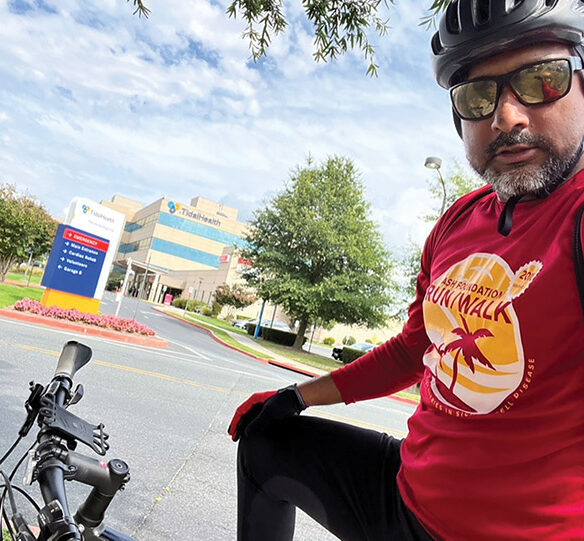
He chose to join TidalHealth because he knew there was an opportunity to help guide the growth and development of the emergent GME program.
In his first few months on the Shore, he missed the trails of Indiana but found he was able to ride the roads in West Salisbury and Hebron in the evenings after work. He also began making connections with others who he drew to the sport, including Dr. Saad.
Before accepting his current role, Dr. Saad graduated from medical school in Lebanon, where he first began cycling. He had also completed his residency in Baltimore and then a pair of fellowships in North Carolina.
He was drawn to TidalHealth by the role’s focus on community oncology and teaching, and by the chance to return to his “home state” of Maryland, where he first immigrated to the U.S. Ultimately, it was the people he met who made the decision easy.
“At the end of the interview, I knew that this was the place,” Dr. Saad said.
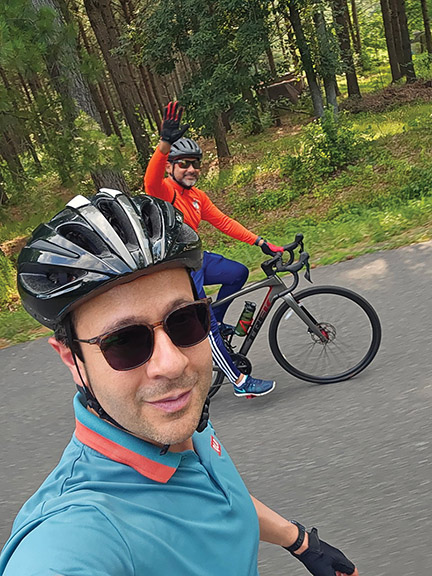
Dr. Saad describes Dr. Siddiqui as sort of a Pied Piper of cycling who has convinced several colleagues to purchase bikes and begin riding, so it wasn’t long before the two began after-work rides where they were able to talk about anything from teaching to nature to nothing at all.
Both registered for the Sea Gull Century this past year, but after a family issue prevented Dr. Saad from competing, Dr. Siddiqui completed the 100-mile race alone and has vowed to push his friend to complete it with him in the upcoming year.
“I think one of the signs that we have a healthy culture in medical education is that we like hanging out with our colleagues after work and the same thing goes for the fellows as well as other people,” Dr. Siddiqui said. “I have always believed that fancy buildings and fancy things don’t make a place. What makes a place is the people inside and what you provide for the patient and how you interact.”
Winter has brought their rides to a temporary halt, but as spring comes around, Dr. Saad plans to sometimes end his commute back to Salisbury from the TidalHealth Allen Cancer Center in Seaford, Delaware, at Dr. Siddiqui’s house, where their bikes are stored together in the garage, waiting to get back on the road.
“I think the thing about these kinds of activities is not just about what they are for Salah and I,” Dr. Saad said. “We hope to get engagement from the fellows and other clinic staff as a way to bond and decompress out of work. So, I think as the program grows, we are hoping we become the nucleus of something bigger within the program like a Hematology & Oncology cycling club that can grow beyond us.”