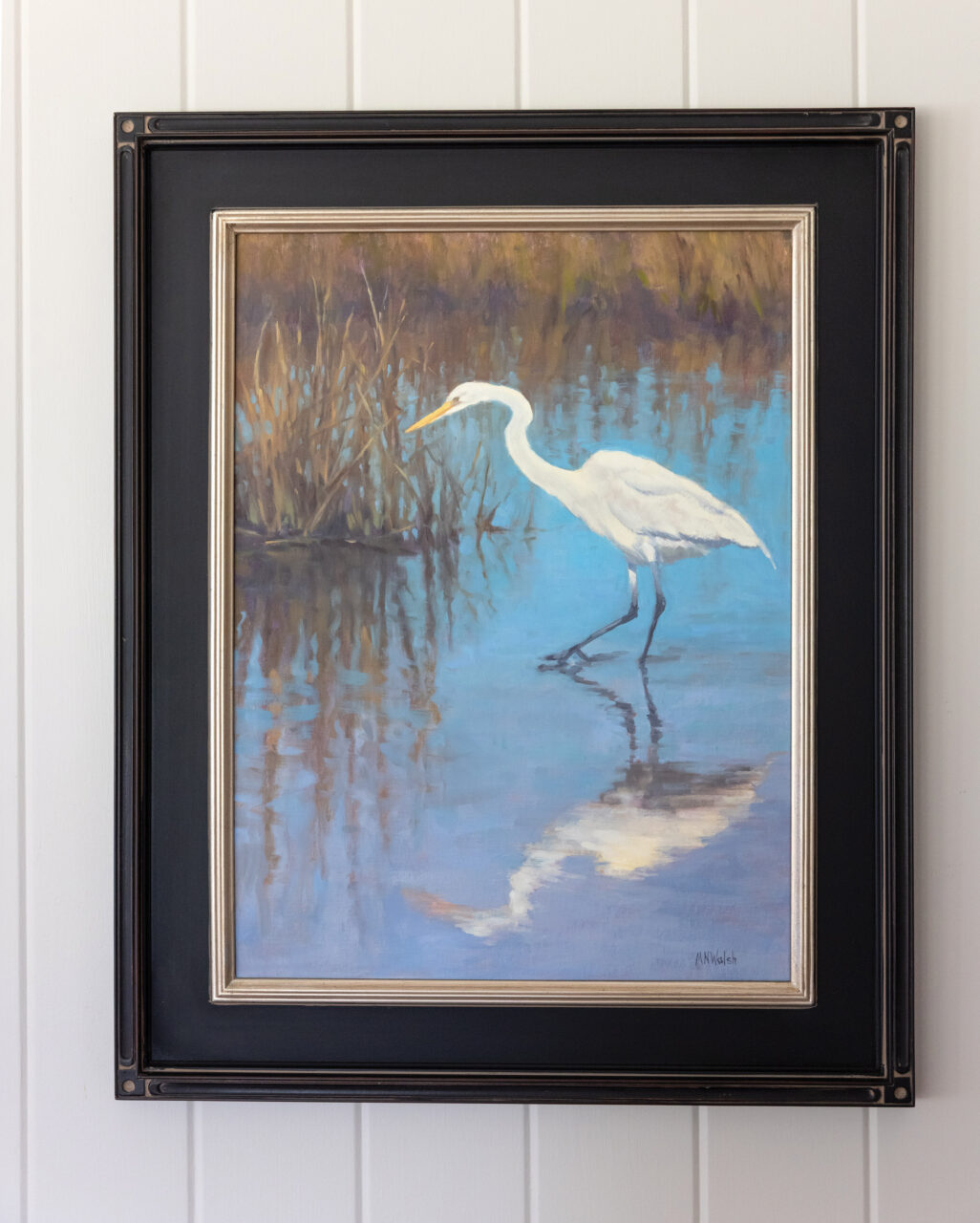
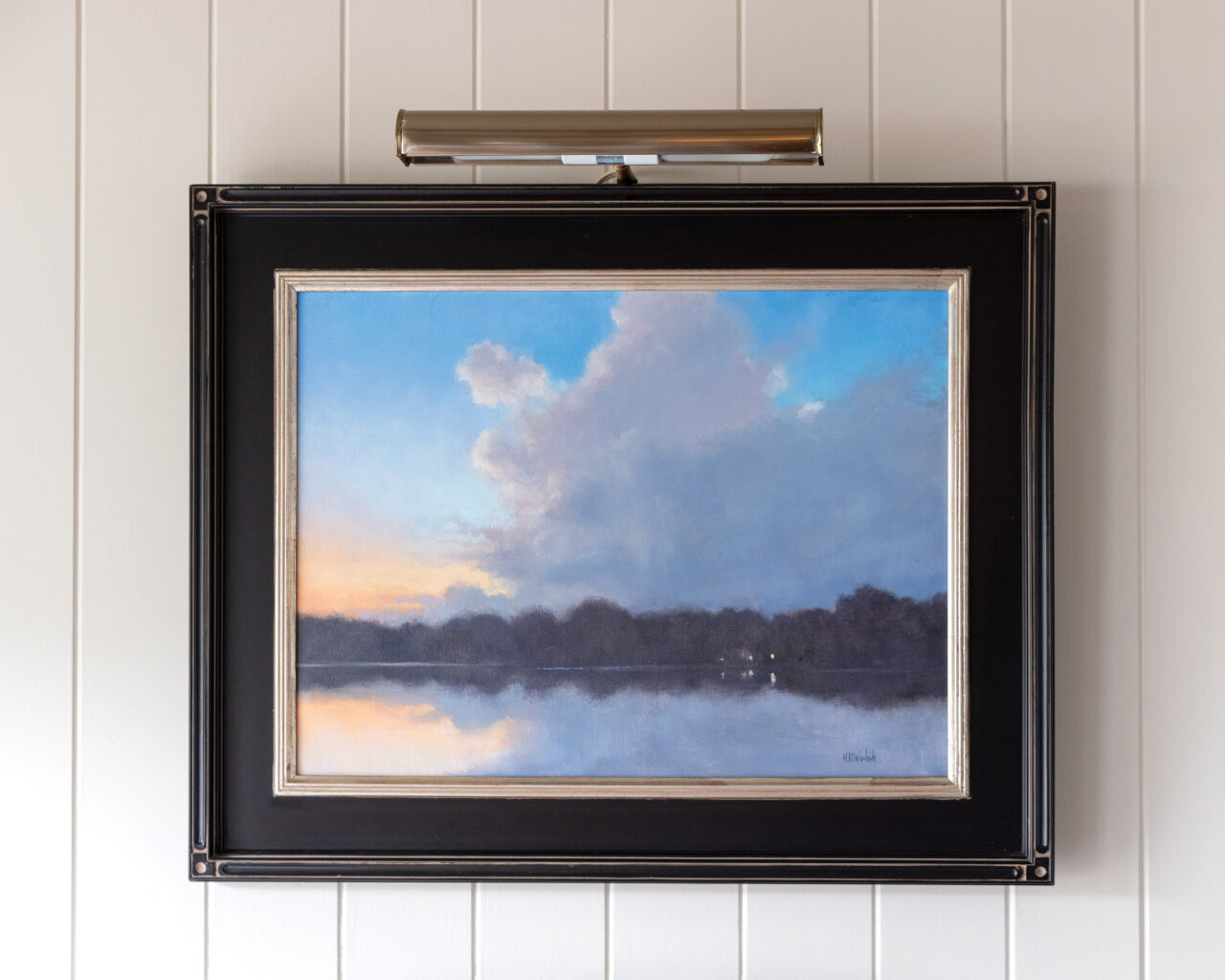
A pattern of light and shadow will stop Meg Walsh in her tracks. Reflections across water, mist lifting off the ground after rain, the layered haze of humidity at sunset—these are the moments that move her from observer to painter.
Now based in Easton, Meg spends her days attuned to the subtle shifts of the Eastern Shore landscape. Deer crossing a field near her home, herons threading through marsh grasses and the nightly theater of Chesapeake Bay sunsets all find their way into her work.
“You walk out your door and it’s right there,” she says of the setting that has shaped her recent paintings. “It’s much easier here to be outside and paint.”
Meg’s work includes landscapes, animals, still lifes and a growing collection of nocturnes inspired by evening skies against water. Many begin the same way: she’s outside, watching how light transforms a subject that might otherwise go unnoticed.
“I love shadows,” she says. “They will hook me every time.”
Painting Her Way
Meg has painted since childhood. At Wake Forest University, where she studied history, a class during her senior year clarified what she already sensed. “This is what I really want to do,” she knew.
Life, however, followed a different path for a time. Meg moved to the Washington, D.C., area and built a 21-year career at National Geographic, eventually working as an editor. Along the way, she kept one foot in the art world, taking evening classes at the Art League School in Alexandria’s Torpedo Factory.
There were pauses and shifts. But by 2000, she was working steadily as an artist, eventually showing in galleries and building a full-time practice.
Portrait commissions—including children and beloved family dogs—once filled much of her schedule.
Recently, one of those early connections resurfaced. A woman whose daughters she painted decades ago tracked her down to commission a portrait of her granddaughter.
“It’s amazing how it comes full circle,” Meg says.
In Plein View
Meg has worked with oil paints and pastels, though oil is her primary medium for now. She’s drawn to its handling and the practical ease of framing. Her process often begins outdoors, even if she finishes painting in the studio.
Earlier in her career, Meg participated in plein air festivals and competitions, setting up with easel, paint box and a backpack full of supplies. She loved the camaraderie, but less so the competitive atmosphere. “Painting outside is kind of a sacred space,” she says. “What I really love is being out there.”
These days, she approaches plein air differently.
Rather than aiming to complete a painting on site, she gathers color, light and atmosphere to bring back to the studio. “I get the feel of the place,” she says. “Then I can be more thoughtful about it.”
Her outdoor kit is streamlined yet substantial: a compact paint box attached to a tripod, a limited palette of warm and cool primaries, white, brushes, solvent and the practical extras—hat, sunscreen, bug spray and water. “I look like I’m going camping,” she laughs.